BY Daniel Bampoe
As Parliament prepares to go on recess, the Minority on the Roads and Transport Committee has issued a comprehensive assessment of the road and transport sector, warning of growing concerns over transparency, stalled projects, and weakening financial commitment under the current administration.
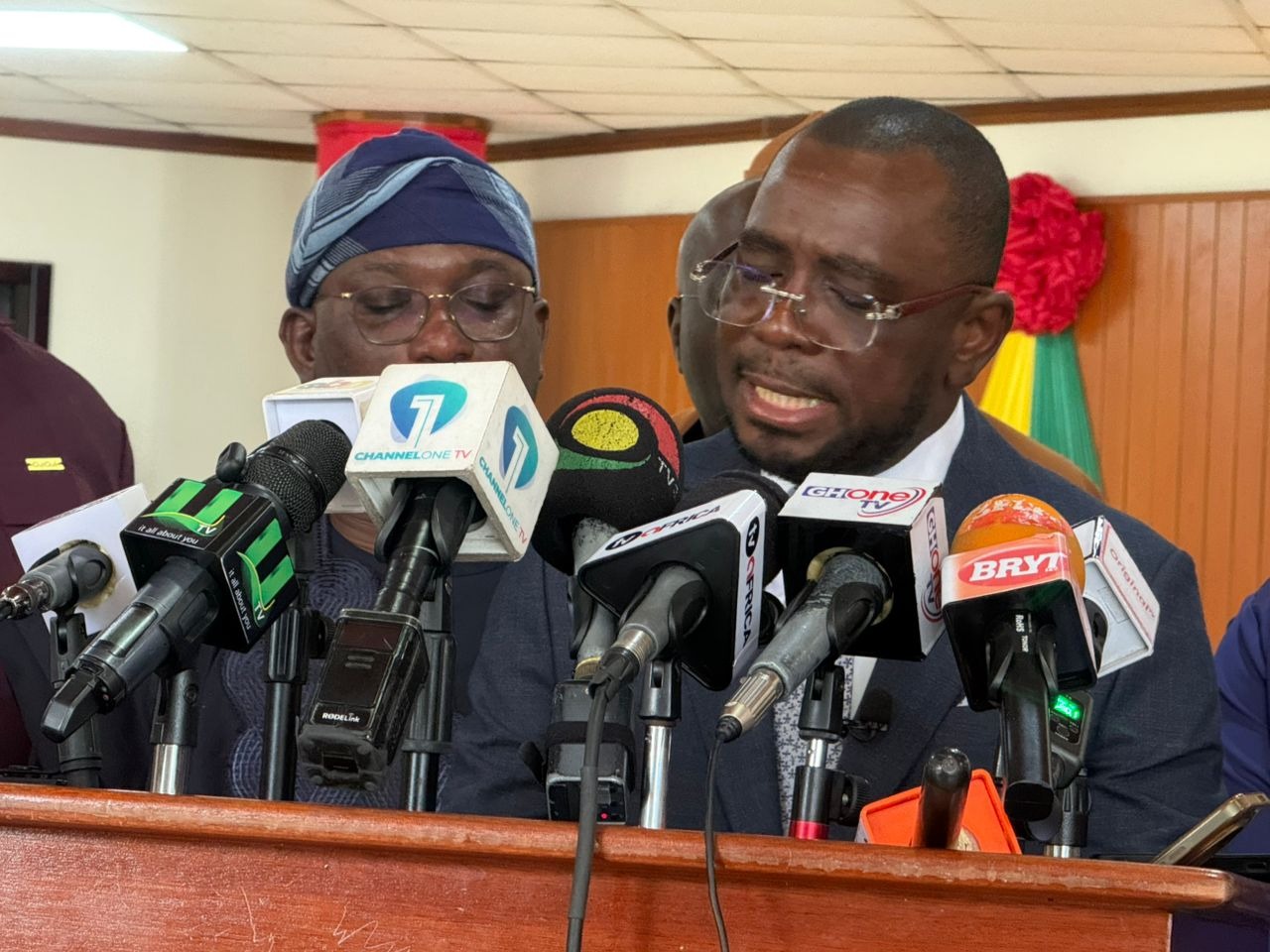
Addressing a press conference, the Ranking Member of the Committee, Kennedy Nyarko Osei, described the sector as a critical pillar of national development—one that underpins trade, mobility, and economic growth—but said recent developments point to troubling signs of policy inconsistency and implementation challenges.
According to the Minority, 15 months into the administration, there are increasing questions about how major infrastructure projects are being managed, particularly regarding transparency and fiscal discipline.
At the center of the concerns is the government’s flagship “Big Push” programme, which is expected to cost approximately GH¢50 billion. While the Minority acknowledges the potential of the initiative to transform connectivity and open up economic corridors, it insists that the process through which the first 50 projects were awarded lacks transparency.
The Caucus is demanding the immediate publication of full contract details, including the identities of contractors, scope of work, and cost per kilometre, arguing that such disclosure is essential for public accountability.
They note that established industry benchmarks place the cost of bitumen roads between $400,000 and $650,000 per kilometre, asphalt overlays between $1.2 million and $1.4 million, and dual carriage roads between $2 million and $2.5 million—figures they say should guide any assessment of value for money.
Beyond new projects, the Minority paints a worrying picture of widespread abandonment of ongoing road works inherited from the previous administration. It claims that over 1,000 projects across all 16 regions—many at advanced stages—have been left idle, with more than 80 percent of contractors demobilized due to lack of payments.
Particularly cited are key bypasses along the Accra–Kumasi corridor, including Osino, Anyinam, Enyiresi, and Konongo, which had reached between 57 and 93 percent completion but have since stalled.
The Minority argues that abandoning near-complete projects not only wastes public funds but also delays critical socio-economic benefits.
In the railway sector, the Minority describes what it calls a sharp decline in government commitment.
Despite over $1.1 billion invested between 2017 and 2024, major projects such as the Tema–Mpakadan line—99 percent complete—and the Kojokrom–Manso line—95 percent complete—remain non-operational or abandoned.
The situation is compounded by the lack of investment in complementary infrastructure such as terminals, which are essential for operational efficiency. The termination of the Adum–Kaase rail project has also been criticized as a missed opportunity to ease congestion in Kumasi.
Financial constraints within the road sector were also highlighted, with the Minority estimating outstanding arrears of about GH¢20 billion owed to contractors. They argue that the release of only GH¢1 billion out of a GH¢5.8 billion allocation is insufficient and has led to widespread project delays and contractor withdrawal.
The Caucus is urging government to explore alternative financing mechanisms, including road bonds, to address funding gaps and restore confidence among contractors.
On the proposed Accra–Kumasi Expressway, the Minority raised concerns over the absence of cost details and budgetary allocation. While acknowledging the long-term benefits of improved connectivity, they caution that compensation and resettlement costs for affected communities could significantly inflate the total project cost.
They argue that without full disclosure of financial implications, it is difficult to assess whether the project represents value for money compared to completing existing road dualization works.
The decision to downgrade the Suame Interchange from a four-tier to a three-tier design has also been questioned, especially since Parliament had already approved financing for the original design.
The Minority insists that any reduction in scope must be justified transparently to avoid compromising long-term benefits.
Additionally, the Caucus criticized delays in reintroducing road tolls, noting that despite earlier commitments, no progress has been made toward implementing a modernized tolling system.
Concerns were also raised over the failure to operationalize the National Roads Authority Act, 2024 (Act 1118), which was intended to streamline road sector management by integrating key agencies under a single authority.
In the aviation sector, the Minority questioned the absence of funding for projects such as the proposed Ho Airport training facility, as well as delays in critical upgrades at Prempeh I International Airport and Tamale International Airport.
They also expressed concern over disputes involving the Ghana Airports Company Limited and McDan Aviation, warning that unresolved conflicts could discourage local investment.
Similarly, attempts to halt the ongoing refurbishment of Terminal 2 at Kotoka International Airport were described as risky, with potential legal and financial consequences for the state.
In the maritime sector, the Minority noted that despite the passage of the Ghana Shippers’ Authority Act, 2024, its regulatory framework has not been implemented, allowing continued imposition of high shipping charges.
Concluding the address, the Minority stressed that its concerns are not politically motivated but aimed at ensuring transparency, accountability, and continuity in infrastructure development.
They called on government to provide full disclosure on major projects, settle outstanding arrears, and prioritize the completion of existing works, warning that failure to do so could undermine the long-term development agenda.