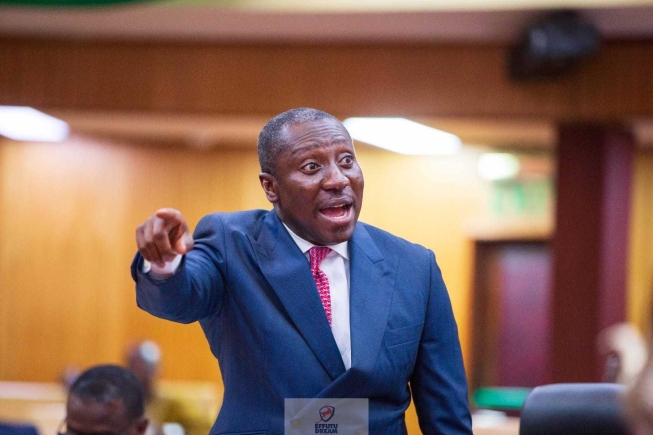
In a stirring and defiant public statement, Ghana’s suspended Chief Justice, Her Ladyship Gertrude Araba Esaaba Sackey Torkornoo, has made explosive claims that a shadowy political force—referred to symbolically as Nebuchadnezzar is behind a targeted campaign to intimidate her into submission or force her resignation.
Addressing the nation with visible resolve, the Chief Justice declared that the ongoing Article 146 removal proceedings are not just an abuse of constitutional processes but a deeply orchestrated political scheme designed to destroy her legacy, silence her dissent, and set a chilling precedent for judicial control in Ghana.
“I have heard veiled threats. I have been told I will suffer harm if I don’t resign,” she said.
“Some want me out not because I have failed in duty, but because I stand in the way of an agenda—an agenda led by what I will now describe as Nebuchadnezzar —forces who seek to dominate justice through fear.”
A Judge Under Siege: Personal Warnings and Pressure to Resign
Justice Torkornoo disclosed that she has been repeatedly advised—even by people who care for her safety—that she should simply walk away rather than subject herself to what many describe as a carefully staged removal process.
Some have urged her to retire early and quietly escape the ordeal. Others, she says, have issued more sinister messages.
But she remains unmoved. “As a lawyer of 38 years, and a judge for over two decades, I cannot surrender to illegality,” she stated. “If I resign, I will be validating a corrupt, opaque and unconstitutional process.”
She cited Supreme Court precedent (Suit No. J6/02/2019) which affirms that a judge facing Article 146 proceedings cannot resign mid-process without forfeiting all benefits and risking judgment by default.
She argued that the framers of the Constitution never intended public officers to be bullied out of office with falsehoods and fear.
Three Petitions, One Agenda
Justice Torkornoo gave a blow-by-blow account of the three petitions forming the basis of her suspension, pointing out factual inconsistencies, legal flaws, and political motivations.
1. Daniel Ofori’s Petition: “Misguided and Personal”
This petition, she said, contains the bulk of allegations—many of which she described as either false, based on ignorance of judicial procedures, or completely irrelevant.
Ofori accuses the Chief Justice of transferring his case to another judge due to bias.
However, Justice Torkornoo clarified that the original judge had travelled abroad due to a family emergency and that court policy requires similar cases to be heard by one judge.
She further explained that other claims—such as traveling with her daughter and husband using state resources—are entirely within the scope of her entitlements, backed by policy and appointment letters.
“Even the Judicial Service’s travel policy permits the Chief Justice to travel with a family member for security,” she said. “I did not buy the tickets myself, and I was not surcharged.”
Even administrative decisions, including judge appointments or staff terminations, were either done before her appointment or based on recommendations from proper authorities like the Judicial Council.
Perhaps most controversially, she noted that Justice Gabriel Pwamang, who once ruled in Ofori’s favour in a case where she dissented, is now chairing the panel investigating her, creating what she believes is an unmistakable conflict of interest.
2. Ayamga Akolgo’s Petition: “A Disrupted Courtroom Now Weaponized”
The second petitioner, Ayamga Akolgo, claims he was wrongfully arrested by the Chief Justice during a Supreme Court session.
But Torkornoo rebutted that he disrupted proceedings after a ruling went against him and had to be escorted out. “His own media evidence confirms this,” she added.
Furthermore, she raised concerns over Justice Pwamang’s presence on this matter too, since he also sat on the panel during Akolgo’s case.
3. “Shinning Stars” Petition: “A Phantom Group, A Phantom Claim”
The third petition came from an unregistered group calling itself “Shinning Stars,” alleging that she refused to hear the Speaker of Parliament during a ruling.
Chief Justice Torkornoo dismissed this claim as constitutionally flawed, emphasizing that no Supreme Court ruling is delivered by a single judge. “Decisions are collective,” she said.
A Fight for Institutional Integrity
Justice Torkornoo made it clear that her resistance is not just for herself but for the future of Ghana’s judiciary.
“If this unconstitutional process succeeds, it opens the door for anyone—any politician, any activist, any ‘Nebuzanizar’—to manufacture a petition and cripple a judge who refuses to conform.”
She warned that the real danger is not her removal, but the weaponization of Article 146 to silence independence across constitutional bodies.
“Behind me are all judges and commissioners. If this is allowed to happen to me as Chief Justice, no one is safe. This is not about me alone. This is about Ghana’s soul.”
A Democracy on the Edge
She ended her remarks with a solemn reference to a 1946 quote by German Pastor Martin Niemöller, warning that silence in the face of systematic injustice eventually consumes everyone.
“First they came for the socialists, and I did not speak out… Then they came for me — and there was no one left to speak for me.”
The Chief Justice concluded with a strong affirmation of her integrity and principles.
“No one can accuse me of taking a bribe. My conscience is clean. But I will not help sanitize this corrupted process with my silence or my resignation.”