By Issah Olegor
The Chief Executive Officer of the National Youth Authority (NYA), Osman Abdulai Ayariga, is facing serious allegations of conflict of interest following a newly announced partnership between the NYA and courier company ShaQ Express.
Critics are questioning the integrity of the deal after evidence emerged suggesting a personal connection between Ayariga and the CEO of ShaQ Express, casting doubt on the transparency and fairness of the engagement.
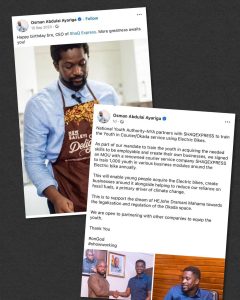
On May 13, 2025, the NYA announced a strategic partnership with ShaQ Express to train 1,000 young Ghanaians annually in electric bike-based delivery and Okada services.
The initiative, according to NYA’s official statement, is part of the agency’s broader mandate to promote youth entrepreneurship, create employment opportunities, and contribute to climate change mitigation by reducing reliance on fossil fuels.
While the partnership aligns with government efforts—particularly those of President John Dramani Mahama, who has promised to legalize and regulate the Okada industry—the announcement has been marred by revelations of a potentially undisclosed personal relationship between the NYA CEO and the head of ShaQ Express.
In a publicly accessible Facebook post dated September 15, 2023, Osman Ayariga personally extended birthday wishes to the CEO of ShaQ Express, referring to him as “bro.”
The message read: “Happy birthday bro, CEO of ShaQ Express. More greatness awaits you!” The post has since resurfaced, prompting allegations that Ayariga may have used his public office to favour a close associate in the awarding of the NYA training contract.
Transparency and anti-corruption advocates have described the situation as a textbook case of conflict of interest, especially if procurement protocols were sidestepped or if there was no open competitive process.
Questions are now being raised about whether the selection of ShaQ Express was subjected to due diligence, value-for-money assessments, or approval from the NYA board.
“No one is saying don’t work with the private sector,” a youth activist told this newspaper, “but when a public official hands over a national training program to someone he openly calls his ‘bro,’ and there’s no evidence of an open tender, then we’re looking at possible abuse of office.”
As the NYA enjoys public funding to implement youth development programs, the matter has also triggered calls for investigations by the Commission on Human Rights and Administrative Justice (CHRAJ), the Public Procurement Authority (PPA), and the Office of the Special Prosecutor (OSP).
It is unclear whether the Ministry of Youth Empowerment, under which the NYA operates, was consulted or approved the agreement.
Stakeholders in the youth empowerment space are demanding that all Memoranda of Understanding (MoUs) and partnership contracts between NYA and private entities be made public for scrutiny.
Neither Osman Ayariga nor ShaQ Express has officially responded to the conflict of interest allegations.
The NYA’s official social media channels, however, continue to promote the partnership using hashtags such as #OnGod and #ShowWorking, with no reference to the controversy.
For now, the success of the training program—and its legitimacy—hinges on whether the NYA can demonstrate that the partnership was procured through fair, competitive, and transparent means.
In an environment where public sector accountability is under increasing scrutiny, the Ayariga-ShaQ Express deal may prove to be an early litmus test for the Mahama administration’s commitment to clean governance.