
BY Daniel Bampoe
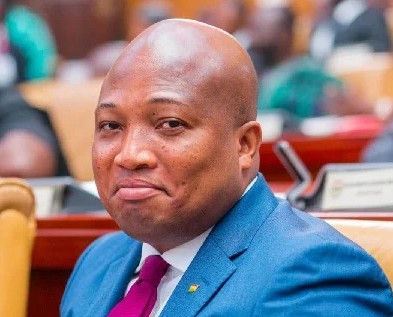
From demanding accountability over Akufo-Addo’s luxury jet travels to defending the Mahama administration’s decisions, from promising a ruthless war against galamsey to facing questions over the government’s performance, and from condemning politically connected Electoral Commission appointments to acknowledging that an NDC-linked appointment has poor optics, Samuel Okudzeto Ablakwa is confronting uncomfortable questions about whether the standards he championed in opposition are being applied consistently under his own government.
Foreign Affairs Minister and North Tongu Member of Parliament Samuel Okudzeto Ablakwa built much of his political reputation on challenging the Akufo-Addo administration over public expenditure, alleged corruption, illegal mining and the independence of state institutions. His public interventions frequently demanded transparency, accountability and strict adherence to principle, with the argument that public officials must be judged by the same standards regardless of political affiliation.
However, since the National Democratic Congress (NDC) returned to power under President John Dramani Mahama in January 2025, several controversies have revived questions about the consistency of Ablakwa’s earlier positions. The latest concerns involve the appointment of a deputy chairperson of the Electoral Commission (EC), the use of private aircraft by officials of the current administration, the government’s handling of illegal mining, and the controversy over his residential arrangements at Airport Hills.
The latest controversy trailing the loquacious and boisterous minister is regarding the evacuation of distressed Ghanaians from South Africa where the mathematics are not adding up.
These issues do not all establish wrongdoing, nor do differences between the circumstances of two administrations automatically prove hypocrisy. Nevertheless, they have created a political test for a minister whose reputation has been closely associated with public scrutiny of those in authority.
The central question is whether Ablakwa’s longstanding demands for accountability are being applied with the same intensity when the decisions under scrutiny are made by a government he serves.
Private Jets: A Promise To Resign Now Haunts Ablakwa
One of the most persistent controversies surrounding Ablakwa concerns his opposition-era campaign against the use of expensive chartered aircraft for presidential travel.
During Akufo-Addo’s presidency, Ablakwa repeatedly questioned the decision to charter aircraft despite the existence of Ghana’s presidential jet, a Dassault Falcon 900 EXE acquired in 2008. He argued that the government had a responsibility to explain why it was spending substantial sums on alternative aircraft when the state already owned a presidential plane.
In an open letter in 2021, Ablakwa challenged Akufo-Addo over the use of a chartered Boeing 737-900ER and other luxury aircraft, insisting that the presidential jet was in what he described as “pristine condition”.
He questioned why the government preferred to lease aircraft at considerable cost instead of using the Falcon, and demanded full disclosure of expenditure associated with presidential travel.
His campaign subsequently included claims about the cost of chartered aircraft, the number of flight hours and the total amount charged to the public purse. In one widely circulated account, he cited an alleged rate of approximately £15,000 an hour for an Airbus ACJ320neo and calculated that 23 flight hours had cost about £345,000, or GH¢2.83 million at the time.
Ablakwa also argued that the government’s chartered travel expenditure had exceeded GH¢100 million. These were figures he advanced in his scrutiny of the previous administration, and his campaign called for the government to account for its decisions.
His argument was not merely that private aircraft were expensive. It was that public officials had a duty to demonstrate value for money, especially when the state already possessed an aircraft intended for official travel.
The controversy became even more politically damaging when Ablakwa was reported to have made a categorical pledge concerning a future Mahama administration.
“If Mahama comes into power and uses a private jet, I will resign,” he reportedly declared during the opposition period, presenting his position as a matter of principle rather than personal loyalty.
He also argued that the issue was not personal and that his political conduct should be guided by consistent principles.
That statement has since become a central point of criticism from political opponents who argue that he should now be judged against the standard he set for himself.
Jane Naana Opoku-Agyemang’s VistaJet Trip
The controversy returned in 2025 following reports that Vice-President Professor Jane Naana Opoku-Agyemang had returned to Ghana aboard a chartered VistaJet aircraft after a medical-related trip abroad.
The reported use of the private aircraft triggered calls from critics for Ablakwa to honour his earlier pledge to resign.
Former Deputy Education Minister and Member of Parliament for Assin South, Rev. John Ntim Fordjour, was among those who challenged him, arguing that the minister’s earlier words should have consequences under the new administration.
The issue was particularly sensitive because Ablakwa had spent years demanding explanations from Akufo-Addo over chartered aircraft, arguing that public funds should not be committed to expensive travel arrangements without adequate justification.
Critics therefore asked why a minister who had once made a categorical promise about private-jet use had not resigned following the controversy involving the Vice-President.
The comparison, however, requires some qualification. A reported charter flight for a Vice-President’s medical-related journey is not automatically identical to every presidential travel arrangement criticised under Akufo-Addo. The purpose of a trip, the availability and suitability of state aircraft, security requirements and the total cost are all relevant to a fair comparison.
Those distinctions do not remove the political question raised by Ablakwa’s reported pledge. They instead make disclosure of the relevant facts more important.
If the minister’s position was that the use of private aircraft was inherently unacceptable, critics argue that the same principle should apply regardless of who occupies the Presidency or Vice-Presidency. If, on the other hand, he believes chartering an aircraft can be justified in particular circumstances, the public is entitled to ask whether that qualification was reflected in his earlier declaration.
Ablakwa previously defended his campaign by insisting: “I owe no one an apology for leading this consequential and noble oversight to protect taxpayers.”
He also maintained that his principled position had not changed and that Ghana needed a presidential travel policy.
Those declarations leave him with a difficult political choice: demonstrate that his standards remain unchanged, explain why the circumstances justify a different response, or reconsider the categorical nature of his earlier pledge.
The issue is not simply whether a minister must resign whenever a private aircraft is chartered. It is whether a public figure who makes an unequivocal promise about what he will do under a future government should be held accountable when the circumstances he described appear to arise.

Galamsey: From Demanding A Tougher Fight To Defending The Government’s Record
Illegal mining, popularly known as galamsey, provides another test of the inconsistency of Ablakwa’s political messaging.During the Akufo-Addo administration, prominent NDC figures, including Ablakwa, were vocal in demanding stronger action against illegal mining. The opposition repeatedly criticised the previous government over the destruction of forest reserves, pollution of rivers and the perceived inability of enforcement agencies to dismantle the networks financing illegal operations.
The issue became one of the major environmental and political battlegrounds in Ghana, with public pressure growing over the contamination of water bodies and the destruction of agricultural land.
Ablakwa’s position was consistent with the NDC’s broader argument that the government needed to demonstrate stronger political will and hold those responsible for illegal mining accountable.
Following Mahama’s return to power, Ablakwa continued to make forceful statements about the government’s commitment to ending the practice. In August 2025, he announced that Mahama would lead a “ruthless and relentless” campaign against galamsey after the tragic death of some senior government officials including ministers of state.
Speaking after a Cabinet meeting, he said: “I can confirm to you that you are going to see a fight that has never been witnessed in this country.” He added that the President would lead a campaign aimed at dealing with what he described as an existential threat to Ghana’s future.
The declaration set a high bar for the administration. It suggested that the government was prepared to move beyond expressions of concern and pursue a sustained campaign against illegal miners and the financiers behind their operations.
Mahama subsequently defended his administration’s approach, telling civil society organisations in October 2025 that he was determined to win the fight and welcomed continued public criticism.
“I have nothing to hide. I don’t gain anything from galamsey. I am not personally involved in illegal mining, and I have no interest in it, so you can be assured that we are all on the same side,” the President said.
He also said the government intended to pursue the financiers of illegal mining and punish those found responsible.
In September 2025, Mahama stated that his administration had not exhausted the powers available under existing law and was therefore reluctant at that stage to declare a state of emergency. He also reported seizures of mining equipment and the recovery of forest reserves from illegal operators.
These statements demonstrate that the government has publicly acknowledged the problem and announced enforcement measures. They do not, by themselves, settle the question of whether the campaign has achieved the results the public expects. That is where Ablakwa’s earlier rhetoric becomes politically significant.
Having described the proposed campaign as unprecedented and promised a relentless fight, the minister must now be judged against the government’s actual performance, not merely the strength of its announcements.
The NPP Minority and other critics have questioned the administration’s handling of galamsey, arguing that its actions have not matched the urgency it expressed while in opposition. In October 2025, the Minority described the government’s approach as a publicity exercise and accused it of failing to deliver the decisive action previously promised. Those are political criticisms, rather than independent findings that the government has taken no meaningful action.
The relevant questions concern whether illegal mining operations are being dismantled sustainably, whether financiers and politically connected interests are being prosecuted, whether polluted water bodies and degraded forests are being restored, and whether enforcement is being applied without fear or favour.
Ablakwa cannot reasonably be expected to control every operation conducted by security agencies or every decision taken by the ministries responsible for mining and natural resources. His responsibility as Foreign Affairs Minister is also distinct from that of the minister directly responsible for the mining sector.
Nevertheless, his public position as a senior member of the administration means that his earlier statements will continue to be used to measure the government’s credibility.
When in opposition, he was entitled to demand urgent action from those in power. Now that his party governs, the same demand for scrutiny applies to his own administration.
The charge of hypocrisy becomes politically persuasive to critics when the language of accountability is perceived to have weakened after a change of government. But a fair assessment must compare the evidence of enforcement, prosecutions and environmental recovery rather than rely exclusively on differences in political rhetoric.
The administration’s challenge is to demonstrate that the “ruthless and relentless” campaign announced by Ablakwa has translated into measurable, sustained results.
Electoral Commission: Ablakwa’s Old Warning Returns
The controversy surrounding the appointment of Emelia Affi Agbenyo as a Deputy Chairperson of the Electoral Commission has revived one of Ablakwa’s earlier arguments about political connections and the independence of electoral institutions.
For years, Ablakwa criticised appointments to public institutions where he believed political allegiance or partisan relationships could undermine public confidence. His opposition-era criticism of the appointment of Dr Bossman Eric Asare as an EC Deputy Chairperson has now returned to public discussion following the appointment of Agbenyo by the Mahama administration.
In a video that resurfaced in October 2026, Ablakwa questioned the appointment of what he described as a known political financier to the Commission.
“If it was President Mahama in power, and he has appointed an out-and-out and known paying patron as an electoral commissioner, I would have said, ask for this. It is not the right thing to do,” he said in the footage.
He also warned that political leaders who abandoned principles of fairness could eventually be caught in their own arguments.”When you don’t act based on principle, when you don’t act based on fairness, you will be caught up in your own web. You will fall in your own trap,” he stated.
The resurfaced comments have become politically awkward because President Mahama has now appointed Agbenyo to the same institution, and critics have questioned her past association with the NDC.
The President swore in Agbenyo and Dr Joseph Kwaku Asamoah on October 12, 2026, following the resignation of Dr Bossman Asare and the retirement of Samuel Tettey. Mahama urged the new officials to perform their duties independently and without favour towards any political party.
The NPP and other critics have questioned whether Agbenyo’s political background could affect perceptions of neutrality. However, a person’s past political association does not, on its own, prove that the person will act improperly or fail to perform constitutional duties independently.
The more immediate political issue for Ablakwa is that he previously used the possibility of a similar appointment under a hypothetical Mahama presidency to illustrate what he considered an unacceptable standard.
Now, with the NDC in government, the minister has had to respond to criticism of an appointment made by his own administration. His latest comments have acknowledged the difficulty.

Speaking about Agbenyo’s appointment, Ablakwa said:
“She [Affi Agbenyo] is a woman of integrity, but the optics don’t look good. I have always maintained that let us have very neutral, independent architects appointed to the EC.” He added that he would have preferred a different situation, while defending her competence and integrity.
That response is important because it shows Ablakwa has not simply dismissed all criticism. He has acknowledged that the appointment creates an unfavourable public perception, even as he argues that Agbenyo is capable of performing the job.
The unresolved issue is whether the appointment meets the same standard of political neutrality that Ablakwa demanded when the NPP was in office.
There is also a distinction between a politically controversial appointment and proof of actual bias. The former can damage public confidence even before any misconduct occurs; the latter requires evidence of conduct or decisions demonstrating partiality.
Ablakwa’s earlier argument was that political leaders should avoid appointments that compromise, or appear to compromise, the independence of the EC. Critics now contend that the same principle should have guided the Mahama administration.
The minister’s acknowledgement that “the optics don’t look good” effectively recognises the reputational problem. It does not, however, establish that Agbenyo is unqualified or that the appointment is unlawful.
The controversy instead places the spotlight on whether the government has applied its own stated principles consistently and whether it has done enough to protect public confidence in the electoral management body.
Airport Hills: Accountability Campaign Meets Questions About His Own Rent
A separate controversy emerged during Ablakwa’s vetting as Foreign Affairs Minister in January 2025, when questions were raised about his residence at Airport Hills, an upscale residential area in Accra.
The issue became politically sensitive because Ablakwa had long presented himself as a champion of transparency and accountability in public life. Critics questioned how he could afford to rent a property in an area associated with high-value real estate while serving as a Member of Parliament.
Minority Leader Alexander Afenyo-Markin challenged his account of the residence, questioning whether the property was genuinely rented. Other political opponents raised questions about the financial arrangements supporting his occupancy.
The controversy prompted comparisons with Ablakwa’s earlier scrutiny of public officials’ assets, expenditure and financial dealings. Critics argued that a politician who demands detailed explanations from others should be prepared to provide comparable information when questions arise about his own circumstances.
Ablakwa denied owning the property and said he was a tenant. He also rejected allegations that the house belonged to him through a relative.
“I challenge them to put out that evidence that shows that the Airport Hills residence belongs to me and that I’ve put it in my sister’s name. That’s absolutely untrue. That property doesn’t belong to me,” he said in February 2025.
To support his account, he asked the estate’s management, Finali Limited, to provide documentation concerning his residential status.
Finali Limited subsequently confirmed that a tenancy agreement had been signed on March 1, 2017, between property owner Husni Altheebeh and Samuel Okudzeto Ablakwa and his wife, Nuhela Seidu. The company also confirmed that a renewal agreement was signed on March 1, 2022, and that the tenancy remained in force.
That documentation supports Ablakwa’s position that he was a tenant rather than the registered owner of the property. It is therefore important not to present allegations that he secretly owned the residence as established facts.
The debate, however, did not end with the question of ownership. It shifted to the cost of the accommodation and how the rent was being paid.
Ablakwa explained that Members of Parliament receive rent allowances as part of their conditions of service. He said the allowance was intended to help MPs secure accommodation, particularly since they were no longer routinely housed in parliamentary accommodation as had been done in the past. In a subsequent interview, he stated:
“What they failed to tell the Ghanaian people is that MPs receive rent allowance.”
He argued that the allowance contributed towards the cost of his residence and challenged critics who suggested that his parliamentary income was insufficient to support the arrangement.
Critics questioned whether the allowance could reasonably cover the cost of a property in such an expensive area. Some commentators cited estimates of high rental values in Airport Hills, but those estimates should not be confused with a verified figure for Ablakwa’s own rent. The publicly reported tenancy documents cited here confirm the existence of the tenancy, but do not establish the precise monthly amount he paid.
That distinction matters. Without the actual rent and a complete account of the financial arrangements, it would be inaccurate to declare that Ablakwa could not afford the property or that he had acted improperly.
The political argument, however, concerns the standard of accountability he has advocated for others. Critics believe that public officials who routinely question the financial conduct of their opponents should be willing to provide clear explanations when similar questions are directed at them.
The Parliamentary Rent Allowance Question
Ablakwa’s explanation that his rent is supported by his parliamentary allowance has become a central part of the Airport Hills controversy.
Okudzeto Ablakwa has argued that MPs receive rent allowances in addition to their base remuneration and has rejected attempts to portray his residence as evidence of wrongdoing. The estate management’s confirmation that he was a tenant also addressed the separate allegation that he owned the property.
The controversy nonetheless creates a political contrast with his earlier emphasis on accountability. Ablakwa has frequently argued that citizens deserve answers about how public money is spent and how public officials conduct themselves. Critics say that standard should also apply to questions about his own accommodation and financial arrangements.
The political controversy remains because Ablakwa’s public reputation is tied to his insistence that accountability should be demanded from those who hold power. His critics are now using that same principle to question whether his explanations meet the standard he has historically expected from others.


