
BY Nadia Ntiamoah
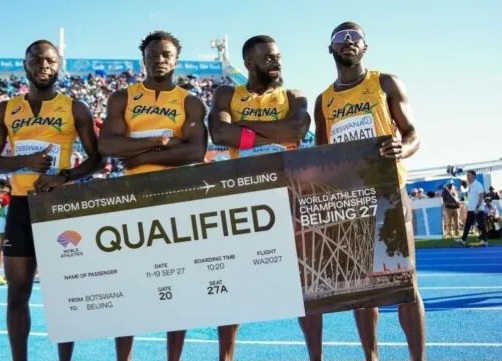
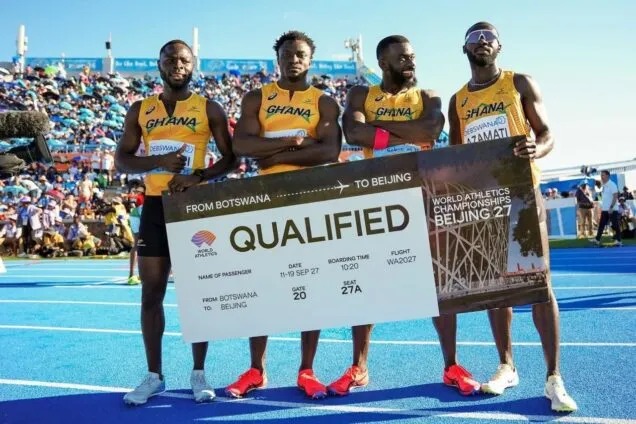
The men’s 4x100m relay team from Ghana secured a remarkable second-place finish behind China at the World Relays in Gaborone, clocking 38.09 seconds to book automatic qualification for the 2027 World Athletics Championships in Beijing.
The achievement marked the fourth consecutive appearance at the global event — a testament to the country’s growing consistency in sprint relays.
Yet, instead of celebration, the spotlight has shifted to a series of logistical failures and travel disruptions that nearly derailed the team’s participation entirely.
Athletes Speak Out Over Travel Ordeal
The controversy gained traction after Ghanaian sprinter Abdul Rasheed Sameenu publicly criticised the handling of the team’s travel arrangements. In a widely circulated post, he lamented the lack of preparation and poor scheduling, highlighting long-haul journeys, extended layovers, and inadequate recovery time for elite athletes.
His comments sparked national debate, raising questions about whether some athletes — including Ibrahim Fuseini — had missed flights due to mismanagement.
Fuseini’s Missed Flight And Planning Breakdown
Fuseini’s situation quickly became central to the controversy. On April 28, just four days before the competition, he was issued an economy class ticket with less than three hours’ notice to travel from Commerce, Texas, to Dallas in order to catch an international flight.
Given the one-hour distance between his base at Texas A&M University and Dallas, the timeline made it practically impossible for him to check in on time. Unsurprisingly, the flight was missed, forcing authorities to reschedule his journey.
The revised itinerary, arranged just two days before the race, involved multiple long-haul flights through New York, Dubai, and Johannesburg, alongside tight connections and extended layovers — all without accommodation provisions.
Even if successful, Fuseini would have arrived too late to participate in the team’s only training session in Gaborone due to accreditation delays. Ultimately, the ticket was cancelled, ruling him out of the event entirely.
Azamati And Sameenu Face Similar Challenges
Top sprinter Benjamin Azamati was also handed a similarly demanding travel schedule, which he declined due to an existing injury. When presented with an alternative plan, it again failed to account for a 14-hour layover in South Africa.
Fortunately, his sponsor stepped in to cover accommodation costs — a critical intervention that prevented further complications.
Meanwhile, Sameenu himself encountered visa-related confusion at the airport, as airline officials were unaware that Ghanaian athletes did not require visas for Botswana. The delay caused him to miss his flight, necessitating another last-minute rescheduling.
Gadayi’s Last-Minute Rescue Mission
In a desperate attempt to assemble a complete relay team, Edwin Gadayi was called up from Kumasi as a replacement. With no flight ticket initially provided, he was instructed to travel by bus to Accra.
Facing severe time constraints and heavy traffic, Gadayi resorted to using a motorbike to reach the airport, a risky but decisive move that ensured Ghana met the minimum requirement of four athletes needed to compete.
He arrived in Gaborone just a day before the race but was unable to train with the team, as he had to complete accreditation procedures while his teammates — Azamati, Sameenu, and Joseph Paul Amoah — trained.
Tactical Adjustments Under Pressure
Due to his late arrival and lack of preparation, the coaching team, led by John Bolton — was forced to adjust their race strategy. Without sufficient time to rehearse baton exchanges, Gadayi was deployed as the anchor leg runner, minimizing the risk of a poor start.
Despite the challenges, he delivered a strong performance, helping Ghana secure second place and qualification.
Administrative Failures Exposed
The episode has exposed significant coordination lapses between the Ghana Athletics and the Ministry of Sports Ghana.
While the Ministry claims Ghana Athletics submitted its funding request late in April, evidence suggests that team selections and competition deadlines had been known since early April.
The World Relays required pre-entry submissions by April 11 and final team confirmations by April 13 — timelines that indicate ample preparation window.
Ghana Athletics has since accepted responsibility, but questions remain about why travel arrangements were delayed until the final days before the event.
Funding Questions And Structural Issues
Financial constraints also appear to have played a role. Although the government reportedly allocated funds to support sports federations in 2026, delays in disbursement meant Ghana Athletics had to scramble for resources to cover essential logistics such as flight tickets.
This disconnect between planning and execution highlights broader systemic challenges in Ghana’s sports administration, particularly for disciplines outside football.
Triumph Against The Odds
Despite the chaos, the relay team delivered on the track securing qualification and maintaining their impressive run at the World Athletics Championships.
However, the circumstances surrounding their success have raised serious concerns about athlete welfare, preparation standards, and institutional accountability.
In the end, the performance in Gaborone stands as both a sporting achievement and a cautionary tale proof that even in adversity, talent can prevail, but also a reminder that success should not come in spite of the system, but because of it.


