BY NADIA NTIAMOAH
The Seventh-day Adventist (SDA) Church has offered to partner with the government to complete and operationalise selected hospitals under the much-discussed Agenda 111 programme, potentially opening a new chapter in efforts to turn several unfinished health facilities into functioning hospitals.
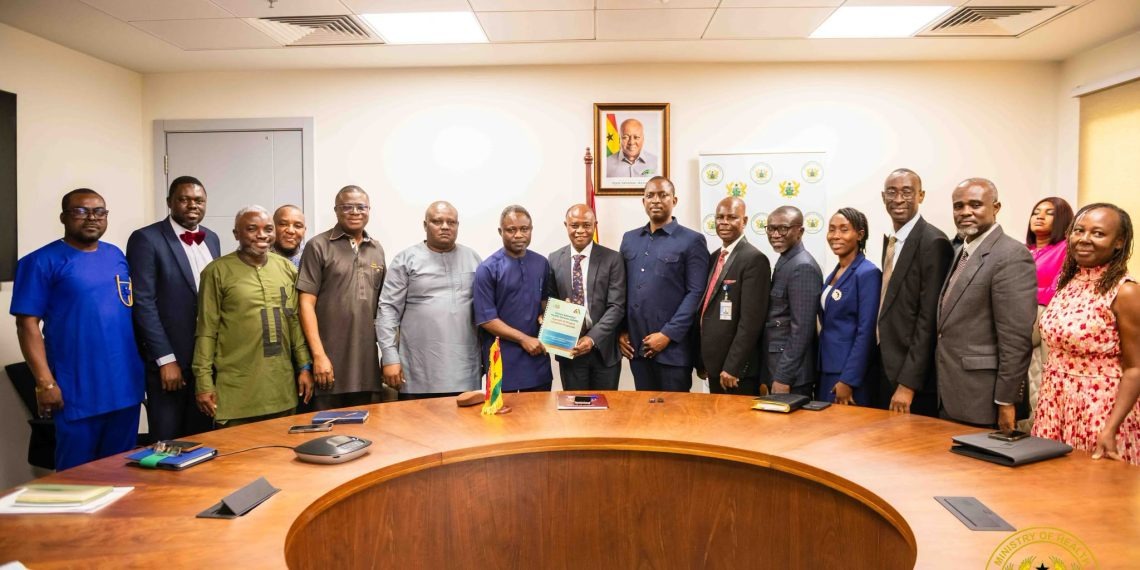
The proposal was presented by the leadership of the Ghana Adventist Health Services of the SDA Church during a courtesy meeting with the Minister for Health, Kwabena Mintah Akandoh.
The intervention comes at a time when the government is seeking stronger collaboration with faith-based organisations and private healthcare providers to address infrastructure gaps and expand access to healthcare, particularly in communities where residents continue to travel long distances to access specialised and essential medical services.
Led by Dr James Antwi, the SDA delegation presented a proposal outlining four areas in which the church believes it can contribute to the country’s healthcare system.
These include trauma care, holistic wellness, oncology and cancer treatment, and rehabilitation and other health services.
The church’s proposal is expected to position its health services as a potential strategic partner in completing and managing selected healthcare facilities, particularly those located in underserved areas.
Agenda 111’s unfinished story
The proposal also brings renewed attention to the history of Agenda 111, one of Ghana’s most ambitious healthcare infrastructure programmes.
The initiative was introduced under the Akufo-Addo administration with the objective of constructing 111 district hospitals and other healthcare facilities across the country.
The programme was conceived as a response to longstanding gaps in Ghana’s healthcare infrastructure, particularly the absence of district hospitals in several districts.
However, implementation became controversial as construction costs rose, financing challenges emerged and several projects remained incomplete.
The programme subsequently became a major political issue, with the New Patriotic Party government defending it as a transformational healthcare investment while critics questioned the cost, financing arrangements, procurement processes and pace of construction.
Under the current administration, the challenge has shifted from announcing the projects to finding the resources and institutional arrangements necessary to complete and operate them.
It is against this background that the Health Ministry is now encouraging faith-based organisations and private healthcare operators to identify facilities they can support.
Government admits it cannot do it alone
Minister for Health Kwabena Mintah Akandoh openly acknowledged that government resources alone may not be sufficient to meet the country’s expanding healthcare needs.
He therefore called for deeper cooperation between the state, faith-based health institutions and private healthcare providers.
“Government alone cannot meet the growing demands of the health sector,” the Minister said, urging organisations under the Christian Health Association of Ghana (CHAG) and private healthcare operators to identify Agenda 111 facilities they could support.
The proposal is not necessarily for private organisations to hand money directly to government.
According to the Minister, interested partners would instead be expected to provide direct support towards the completion and operationalisation of specific facilities.
He assured potential partners that government would provide the necessary guidance and support to facilitate the process.
The arrangement could therefore create a model in which faith-based organisations and private operators help complete, equip or manage selected facilities while the state maintains its broader responsibility for national healthcare policy and access.
SDA identifies four areas of intervention
The SDA Church’s proposal focuses on areas in which its existing healthcare experience could complement government efforts.
The first is trauma care, an area that continues to be important because of road crashes, occupational injuries and other emergencies requiring immediate medical attention.
The church also proposed holistic wellness, reflecting the SDA’s longstanding emphasis on preventive health, healthy lifestyles and integrated approaches to physical and mental wellbeing.
Another major area is oncology and cancer treatment, a specialised field in which Ghana continues to face infrastructure, equipment and human-resource constraints.
The fourth area is rehabilitation and health services, which could include longer-term care for patients recovering from injury, illness or other medical conditions.
The proposal could potentially help reduce pressure on major teaching hospitals by bringing specialised services closer to communities.
6 new regional hospitals planned
Beyond Agenda 111, the Health Minister disclosed that government is planning to construct six regional hospitals in the newly created regions.
Three of the facilities are expected to be constructed this year, with the remaining three planned for 2027.
The announcement forms part of government’s broader effort to expand healthcare infrastructure beyond the country’s traditional regional and teaching hospital centres.
The Minister’s position is that new infrastructure must be accompanied by appropriate staffing and specialised services if Ghana is to make meaningful progress towards Universal Health Coverage.
Government expands specialised cardiac care
Akandoh also disclosed plans and ongoing projects aimed at improving specialised cardiac healthcare.
According to him, two cardiology centres are being constructed — one in Tamale and another at the Komfo Anokye Teaching Hospital.
He further disclosed that a cardiac catheterisation laboratory at the Korle Bu Teaching Hospital had recently been installed and commissioned by President John Dramani Mahama.
Such facilities are expected to improve Ghana’s capacity to diagnose and treat complex cardiovascular conditions that previously required patients to seek treatment abroad or face long waiting periods.
Three flagship health interventions
The Minister also highlighted three major interventions being pursued by the government as part of its healthcare agenda.
These are the Free Primary Healthcare initiative, the uncapping of the National Health Insurance Scheme (NHIS), and the Ghana Medical Care Trust Fund.
The government says the interventions are intended to expand access to healthcare and support Ghana’s ambition of achieving Universal Health Coverage by 2030.
The uncapping of NHIS funding, in particular, is expected to provide additional financial space for the scheme to settle claims and improve access for beneficiaries.
The Ghana Medical Care Trust Fund is also intended to support people requiring treatment for serious medical conditions and reduce the financial burden associated with major illnesses.
The doctor-posting controversy
The Health Minister also reiterated government’s position that doctors must accept postings to designated areas as part of efforts to correct the unequal distribution of medical professionals across the country.