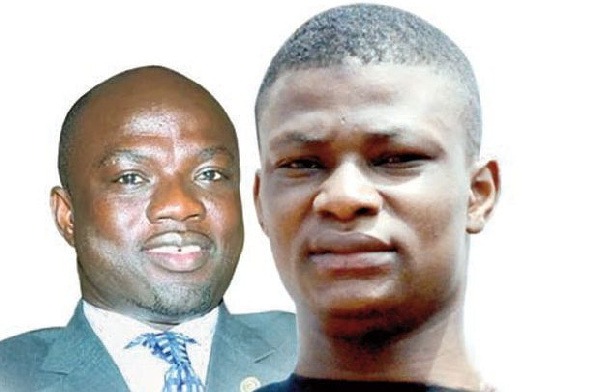
By Daniel Bampoe
The legal battle surrounding the conviction of New Patriotic Party (NPP) Ashanti Regional Chairman Bernard Antwi-Boasiako, popularly known as Chairman Wontumi, is set to move to the Court of Appeal after his lead counsel, former Abuakwa South MP Samuel Atta Akyea, disclosed that his legal team has identified more than 20 separate grounds on which they intend to challenge both the conviction and the 20-year prison sentence imposed by the Accra High Court.
The announcement comes barely days after the Criminal Division of the Accra High Court, presided over by Justice Audrey Kocuvie-Tay, convicted Chairman Wontumi and his company, Akonta Mining Limited, on six counts relating to the unlawful assignment of mineral rights without ministerial approval and facilitating unlicensed mining activities on the company’s Samreboi concession in the Western North Region.
The court subsequently sentenced Chairman Wontumi to two concurrent 20-year prison terms with hard labour and imposed a fine of 10,000 penalty units, equivalent to GH¢120,000, while Akonta Mining Limited was also fined on separate counts.
The judgment marked the climax of a prosecution initiated by the Attorney-General’s Office following investigations into mining activities allegedly carried out on the Samreboi concession by third parties without the approval of the Minister responsible for Lands and Natural Resources.
Throughout the trial, the prosecution maintained that Chairman Wontumi knowingly permitted Henry Okum and Michael Gyedu Ayisi to undertake mining operations on the concession without the mandatory ministerial authorization, thereby facilitating illegal mining contrary to the Minerals and Mining Act.
However, the defence has consistently rejected the prosecution’s case, insisting that Chairman Wontumi lawfully acquired the concession and never unlawfully assigned or transferred his mineral rights. During the trial, Chairman Wontumi testified that Henry Okum had only been engaged to reclaim degraded portions of the concession by planting coconut trees and not to undertake mining.
The High Court rejected that explanation after relying heavily on circumstantial evidence and concluding that the accused knowingly permitted unauthorized mining activities.
Following the conviction, Samuel Atta Akyea announced that the legal team had immediately begun preparing an appeal and had compiled more than 20 grounds upon which the conviction and sentence would be challenged before the Court of Appeal.
According to the defence, one of the central issues is what it describes as the misapplication of the Constitution and the Minerals and Mining Act.
Throughout the proceedings, Atta Akyea argued that provisions of the Minerals and Mining Act relied upon by the prosecution raised constitutional questions that ought to have been referred to the Supreme Court for interpretation.
Before judgment was delivered, the defence filed applications requesting the High Court to stay proceedings and refer key constitutional questions to the Supreme Court, particularly regarding the interpretation of Section 99(2)(b) of the Minerals and Mining Act.
The defence argued that the provision was ambiguous and that only the Supreme Court had the constitutional mandate to determine its meaning.
Justice Audrey Kocuvie-Tay dismissed the application, ruling that the statutory provisions were “clear and unambiguous” and therefore did not require constitutional interpretation by the apex court.
The defence now argues that the refusal to make the referral denied Chairman Wontumi a fair hearing and constitutes one of the major grounds of appeal.
Another major issue expected to feature prominently in the appeal concerns what the defence describes as the denial of Chairman Wontumi’s right to a fair trial.
On the day judgment was scheduled to be delivered, Atta Akyea requested an adjournment, explaining that he had a prior professional engagement outside Ghana and could not be present in court. He also sought to halt the delivery of judgment pending the determination of constitutional issues.
The High Court rejected both applications and proceeded to deliver judgment in his absence.
The defence maintains that the refusal to accommodate the lead counsel prejudiced the accused’s constitutional right to counsel of his own choice.
The appeal is also expected to challenge the trial court’s reliance on circumstantial evidence. Lawyers representing Chairman Wontumi have argued that the prosecution failed to produce direct evidence proving that he unlawfully assigned or transferred mineral rights to any third party, insisting that the conviction was based largely on assumptions and inferences rather than proof beyond reasonable doubt.
Another key aspect of the appeal will focus on the High Court’s decision to lift the corporate veil of Akonta Mining Limited and treat the company and Chairman Wontumi as one entity.
Justice Kocuvie-Tay ruled that there was no functioning management or executive board within the company and concluded that Chairman Wontumi was the true controlling mind behind all decisions taken by Akonta Mining during the period under investigation.
The defence is expected to argue that the trial court improperly disregarded the legal principle of separate corporate personality by attributing the company’s actions directly to Chairman Wontumi.
Co-counsel for the defence has also described the 20-year custodial sentence as “mind-boggling,” arguing that the punishment imposed by the High Court was excessively severe considering the nature of the offences and the evidence presented during the trial.
In addition to seeking a complete reversal of both the conviction and sentence, the legal team is expected to file applications before the Court of Appeal seeking a stay of execution, which, if granted, could suspend the enforcement of the custodial sentence pending the determination of the appeal.
The appeal enjoys the full backing of the New Patriotic Party, whose national leadership has described Chairman Wontumi’s conviction as a “travesty of justice” and declared him a “political prisoner.”
Addressing a press conference after the judgment, NPP General Secretary Justin Kodua Frimpong argued that the prosecution failed to establish any unlawful assignment or transfer of mineral rights and insisted that the conviction rested on assumptions rather than evidence.
The Minority Caucus in Parliament has equally rallied behind Chairman Wontumi, describing the judgment as fundamentally flawed and identifying what it calls four major legal defects, including the refusal to refer constitutional questions to the Supreme Court, the denial of counsel of choice, and the lifting of Akonta Mining’s corporate veil.
The caucus has called on the Court of Appeal to subject those issues to rigorous scrutiny.