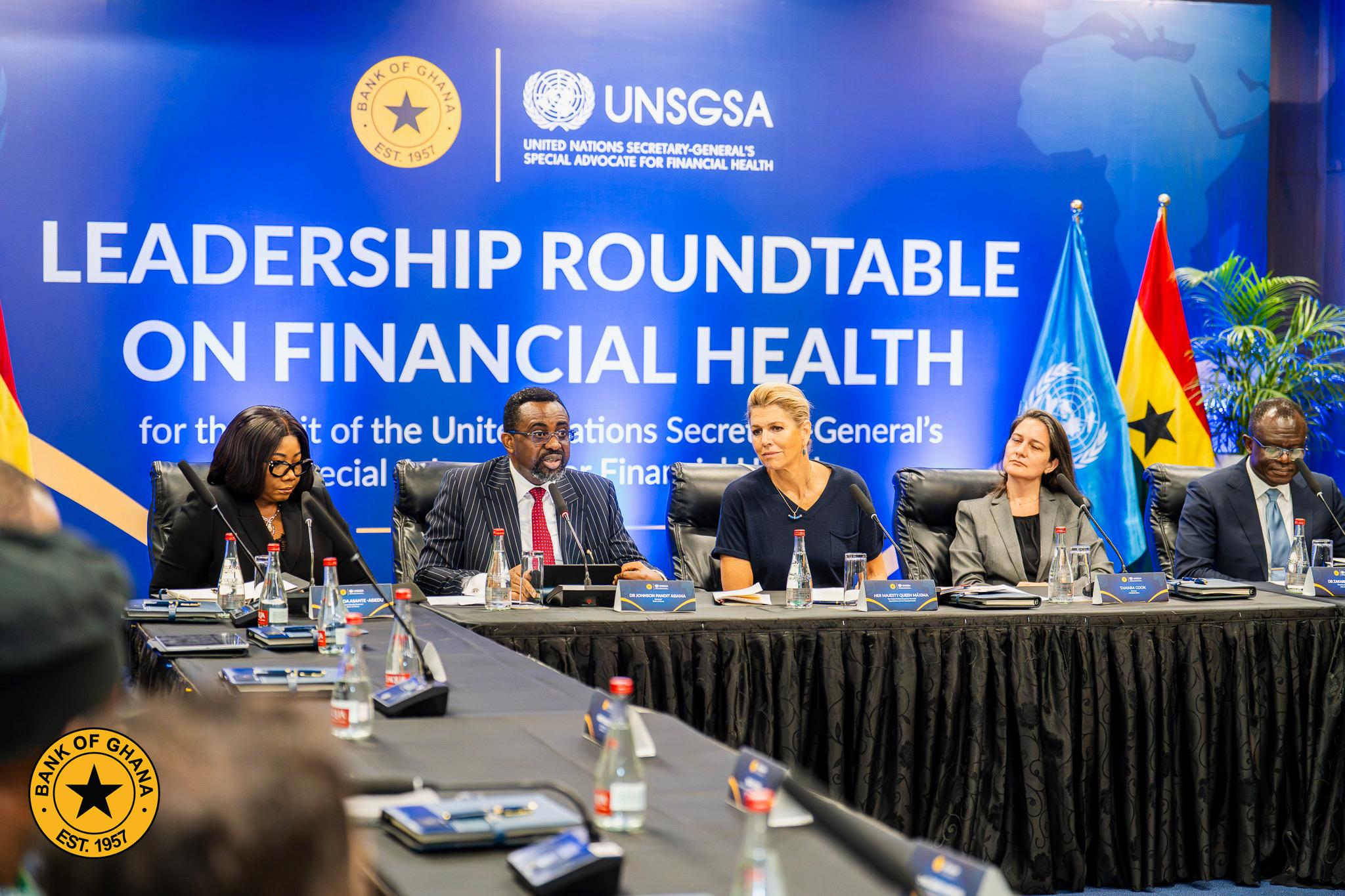
The Governor of the Bank of Ghana (BoG), Dr Johnson Pandit Asiama, has called for a renewed national focus on improving financial health, stressing the need to move beyond expanding access to financial services to ensuring that individuals and businesses can use them to build sustainable financial futures.
According to him, although Ghana has made remarkable progress in financial inclusion over the past decade, the country must now concentrate on translating improved access to financial services into better financial outcomes for households and businesses.
Dr Asiama made the remarks on Wednesday, November 4, 2026, when he delivered a keynote address at the Financial Health Leadership Roundtable at the Bank Square in Accra to mark the visit of Queen Máxima of the Netherlands, the United Nations Secretary-General’s Special Advocate for Financial Health.
Welcoming Queen Máxima and other stakeholders to the event, the BoG Governor expressed appreciation for her longstanding leadership in promoting financial inclusion and advancing the global financial health agenda.
He also acknowledged the participation of representatives from government, regulatory institutions, financial sector organisations, development partners and industry, describing their presence as evidence of growing recognition that improving financial health requires collective action.
Dr Asiama noted that Ghana’s financial sector had undergone significant transformation over the past decade through innovation, collaboration and investment in digital infrastructure.
He said the expansion of interoperable payment systems, mobile money services, fintech innovation and a supportive regulatory environment had made financial services more accessible to millions of Ghanaians, positioning the country among Africa’s leading digital finance markets.
However, he cautioned that access to financial services alone was not sufficient to guarantee improved financial well-being.
He explained that financial health goes beyond having access to bank accounts and digital payment platforms, as it is also influenced by savings, insurance, pensions, investment opportunities and financial literacy.
The Governor identified productive and responsible credit as one of the most important pathways to improving financial health in Ghana, explaining that properly designed credit facilities could help households invest in their future while providing businesses with the capital needed to expand, innovate and create employment opportunities.
He particularly highlighted the financing challenges confronting micro, small and medium-sized enterprises (MSMEs), describing them as the backbone of Ghana’s economic activity.
According to him, MSMEs across the country continue to create jobs, promote innovation and support livelihoods, but many viable businesses struggle to secure the financing required to grow.
He observed that some businesses with strong growth potential are unable to access credit because of unfair lending mechanisms and other barriers within the financial system.
Dr Asiama therefore called for greater use of technology, data and innovation to address information gaps, widen access to credit and establish fair and sustainable financing arrangements for businesses.
He stressed that closing the financing gap would require innovative approaches capable of ensuring that viable enterprises, particularly smaller businesses, are not excluded from opportunities to access financial resources.
The BoG Governor said the Financial Health Leadership Roundtable offered an important platform for stakeholders to discuss practical measures to strengthen financial resilience and improve access to productive credit.
He challenged participants to explore ways of expanding financing opportunities for MSMEs, women and smallholder farmers while strengthening savings, insurance and long-term financial security.
He further emphasised the need to ensure that the next generation of financial services delivers meaningful benefits to individuals and businesses rather than focusing solely on the expansion of financial access.
Dr Asiama called for stronger partnerships among government, regulators, financial institutions, industry players and development partners to identify existing barriers and develop practical solutions.
He urged participants to make the discussions action-oriented and leave the meeting with clear priorities and concrete commitments that would advance Ghana’s financial health agenda.
The Governor expressed gratitude to Queen Máxima for her visit and continued commitment to promoting financial health globally, expressing optimism that the roundtable would produce meaningful outcomes for Ghana’s financial sector.
The meeting forms part of broader efforts to strengthen financial inclusion and ensure that access to financial services translates into improved livelihoods, stronger businesses and greater economic resilience.