BY Grace Zigah
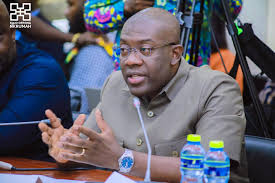
The Member of Parliament for Nhyiaeso, Dr. Stephen Amoah, has dismissed claims that the current economic stability being experienced under the National Democratic Congress (NDC) government is a result of its fiscal management policies. According to him, the Mahama-led administration is merely reaping the benefits of a strong economic foundation laid by the New Patriotic Party (NPP) during its tenure.
Speaking to JoyNews on Wednesday, ahead of the presentation of the 2026 Budget Statement and Economic Policy, the former Deputy Finance Minister argued that the NPP government left behind a well-capitalized economy, strong reserves at the Bank of Ghana, and key structural reforms that have cushioned the current administration.
“As of January, the NPP government had over $1 billion at the Bank of Ghana. The cedi’s current stability is not the making of the NDC — it’s the result of prudent fiscal management and monetary discipline that we left behind,” Dr. Amoah said.
He added that investor confidence in Ghana’s economy often improves after peaceful elections, suggesting that the NDC government has not introduced any extraordinary policies to stabilize the cedi.
“When elections are peaceful, investors gain confidence and invest more in the country. So, the NDC hasn’t done anything special to stabilize the cedi. What they are enjoying is the result of NPP’s hard work,” he emphasized.
NPP’s Economic Framework And Transition
The New Patriotic Party, which governed from 2017 to 2024, pursued an aggressive economic reform agenda focused on fiscal consolidation, domestic production, and financial sector stability.
Under former Finance Ministers Ken Ofori-Atta and later Dr. Mohammed Amin Adam, the NPP implemented measures to strengthen the banking sector, stabilize inflation, and grow foreign reserves.
By early 2024, Ghana had recorded improved external balances and had begun a gradual recovery from the severe economic shocks of COVID-19 and the Russia-Ukraine conflict, both of which had weakened global commodity prices and triggered inflationary pressures.
The NPP also left behind an IMF Extended Credit Facility (ECF) framework, which continues to shape Ghana’s macroeconomic direction today. Dr. Amoah argues that the current fiscal and monetary indicators — including a stabilised cedi, declining inflation, and a growing reserve position — are direct continuations of NPP-era policies rather than new innovations by the Mahama administration.
Fiscal Sustainability
Stephen Amoah also weighed in on the ongoing debate over taxation and revenue mobilization, cautioning that while the call for tax reductions is understandable, it must not undermine fiscal discipline.
He stressed that Ghana’s domestic revenue generation remains insufficient to cover government expenditure, and therefore, any tax relief must be balanced with sustainable revenue alternatives.
“The amount of money we generate domestically is always far less than what we spend. If you want to remove taxes, that’s fine — but you must tell us how the fiscal gap will be filled, especially when we’re managing debt repayments,” he said.
He emphasized that the goal of any responsible government should be to reduce borrowing and strengthen domestic revenue capacity to ensure economic independence.
“We must generate enough revenue, not to overburden citizens, but to make Ghana self-reliant and reduce our dependence on foreign loans,” Dr. Amoah added.
Economic Context
The presentation of the 2026 Budget by Finance Minister Dr. Cassiel Ato Forson has reignited partisan debate over who deserves credit for Ghana’s recent economic rebound.
While the NDC government has touted its performance — citing a decline in public debt from GH₵726.7 billion (61.8% of GDP) in 2024 to GH₵630.2 billion (45% of GDP) by October 2025, and a stronger cedi — opposition figures like Dr. Amoah argue that these achievements are part of an economic trajectory the NPP set in motion before leaving office.
Indeed, under the NPP’s stewardship, Ghana’s foreign reserves were bolstered by Eurobond inflows and robust cocoa, gold, and oil export receipts. By January 2025, the Bank of Ghana reportedly held over $8 billion in reserves, a buffer that helped stabilize the currency as the new government took over.